
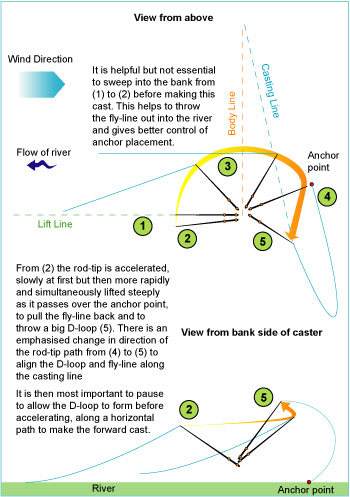
It is fair to say that the single Spey cast with a 90 degree change of direction is the most difficult to master and requires considerable skill and fly-line control. To accomplish this casting technique is very important to fully understand the basic concepts of the jump roll cast because this contains the same basic elements but without a change in direction between lifting the fly-line and making the forward cast. To achieve the direction, change the body has to be turned, although the feet (or at least the leading foot) are facing along the final body line, in position to make the forward cast. Therefore, the body has to be twisted at the hips, so that the arms are facing downstream, along the lift-line, before commencing the cast.
The fly-line is lifted by using the hands in the normal manner as described earlier but as the body is rotated the hands and arms are more or less locked in position and it is the body movement which moves the line gently the anchor position. Lifting the rod-tip higher before making the transfer from the lift to the anchor position helps to prevent the fly-line from travelling too far upstream. Also a preliminary sweep into the bank, after lifting, helps by causing the fly-line to go out to midstream and then back for the D-loop.
Now follows the tricky part. As the rod-tip passes over the intended anchor point, there is a rapid change in direction so that the rod-tip tracks back towards the D-loop set-up position but in one continuous movement. Fast acceleration is required at this stage to pull the fly-line into the casting direction and to produce a good D-loop. Some compromise is made because the anchor point will be forward of the ideal position and so there will be a longer length of fly-line on the water, which reduces the efficiency of the cast.
The continuous movement of the rod-tip, back to the delivery position for the forward cast, causes the loop to be pulled round, pivoting on the anchor point, until the desired D-loop is formed in readiness for the forward cast.
Whilst the loop is being pulled round it is important to maintain the rod-tip path as previously explained for forming a D-loop. Therefore, the rod-tip is swept around from above the anchor placement position and raised, slowly at first and the more rapidly, up to the final set-up position.
